
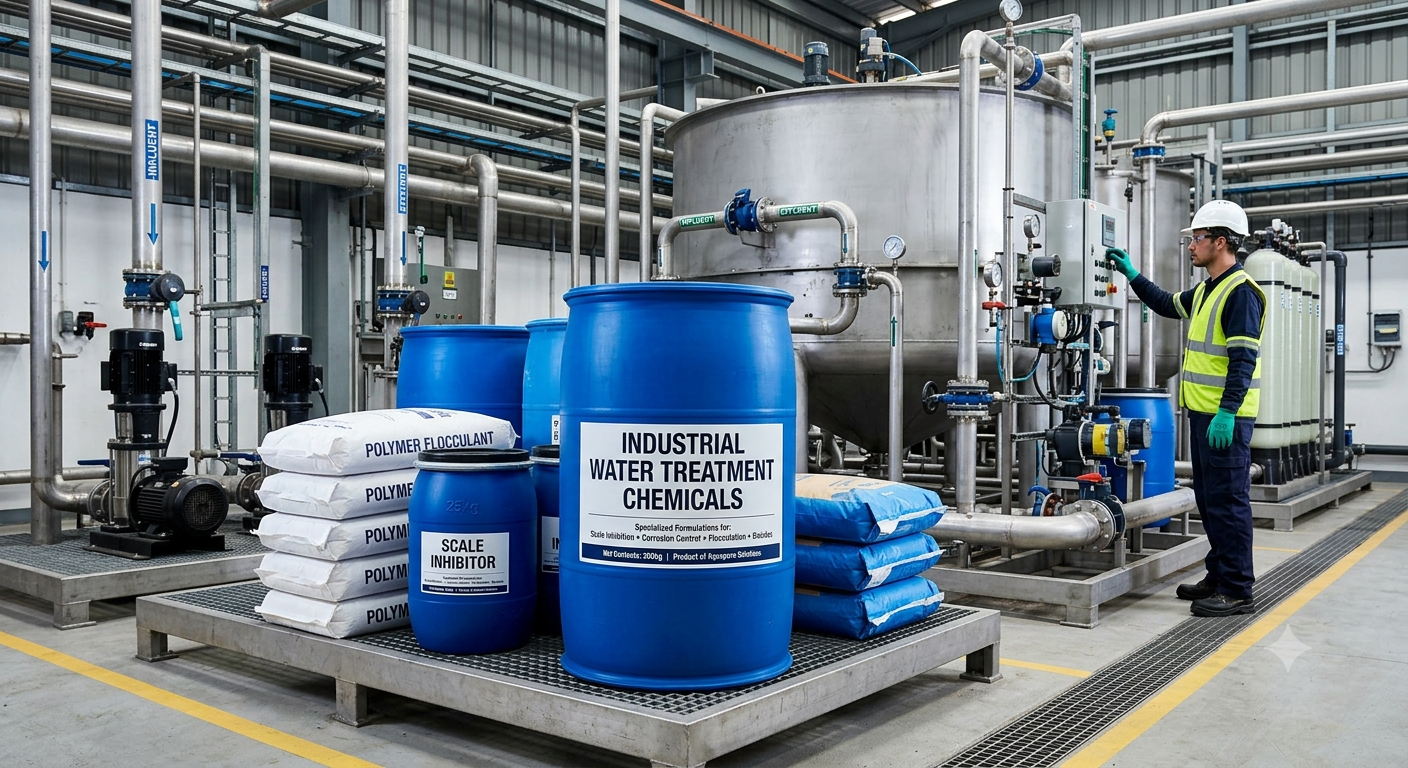
Every industrial plant that touches water - a boiler house, a cooling tower, a dyeing unit, a food processing line - eventually runs into the same four enemies: scale, corrosion, biological growth, and suspended solids. Left unchecked, these problems shut down equipment, inflate energy bills, and trigger pollution control notices. The fix, in most cases, isn't a bigger machine. It's the right chemistry.
This guide breaks down everything you need to know about industrial water treatment chemicals - what they are, how they work, which type fits which application, and how to choose a dependable water treatment chemicals manufacturer in India. Whether you manage a boiler, a cooling tower, an ETP, or a full water treatment plant, this article is built to answer your real, operational questions.
Industrial water treatment chemicals are specialized formulations - coagulants, flocculants, biocides, scale and corrosion inhibitors, pH adjusters, and descalers - used to condition raw water, process water, boiler feedwater, cooling water, and wastewater in industrial settings. They prevent scaling and corrosion, control microbial growth, remove suspended solids and contaminants, and help industries meet CPCB/SPCB discharge norms while extending equipment life and lowering operating costs.
Key Takeaways
- Industrial water treatment chemicals fall into six broad categories: coagulants, flocculants, scale inhibitors, corrosion inhibitors, biocides, and pH adjusters.
- The right chemical program depends on your water source, plant type, and discharge requirements - not a one-size-fits-all product.
- Untreated industrial water causes scaling, corrosion, fouling, and compliance violations, all of which carry direct financial cost.
- Working with an experienced industrial water treatment chemicals supplier who offers dosing guidance and technical support reduces trial-and-error and downtime.
- Regulatory compliance (CPCB/SPCB norms) is now a core reason industries invest in treatment chemicals, not just an afterthought.
What Are Industrial Water Treatment Chemicals ?
Industrial water treatment chemicals are formulated products added to water systems - intake water, process water, boiler and cooling circuits, or wastewater - to control impurities and protect infrastructure. Unlike household water filters, these are engineered for high-volume, continuous industrial operations where water quality directly affects production output, equipment lifespan, and legal compliance.
At their core, these chemicals perform one or more of these jobs :
- Separate solids from liquids (coagulation and flocculation)
- Prevent mineral deposits from forming on hot surfaces (scale inhibition)
- Protect metal surfaces from oxidation (corrosion inhibition)
- Control bacteria, algae, and biofilm (biocides)
- Adjust and stabilize pH for safe downstream reactions (pH adjusters and boosters)
Expert insight : A well-designed industrial water treatment chemical solution is rarely a single product - it's a combination of two or three chemistries dosed at the right stage of the water cycle, tuned to your specific raw water and effluent profile.
Key takeaway : Industrial water treatment chemicals are not optional additives - they are functional inputs that determine whether your water system runs efficiently or fails prematurely.
Why Is Industrial Water Treatment Important ?
Untreated or poorly treated water is expensive in ways that don't always show up immediately. Scale buildup inside a boiler tube, for instance, acts as an insulator - it can raise fuel consumption significantly before anyone notices the drop in efficiency. Corrosion silently thins pipe walls until a leak forces an unplanned shutdown. Biological fouling clogs cooling towers and heat exchangers, cutting heat transfer efficiency.
Beyond equipment, there's the regulatory dimension. Indian industries discharging effluent must meet CPCB (Central Pollution Control Board) and respective SPCB (State Pollution Control Board) norms for parameters like BOD, COD, TSS, and TDS. Non-compliance can mean penalties, closure notices, or reputational damage.
Why it matters :
- Protects capital-intensive equipment (boilers, RO membranes, heat exchangers, pipelines)
- Reduces unplanned downtime and maintenance costs
- Ensures legal compliance with pollution control norms
- Supports sustainability and Zero Liquid Discharge (ZLD) goals
- Improves product quality in water-intensive processes (textiles, food & beverage, pharma)
Real-world example : A textile dyeing unit discharging effluent with high color and COD load typically needs a coagulant paired with a COD and color remover before the water can even enter biological treatment. Skipping this step often means repeated non-compliance flags from the SPCB.
How Do Industrial Water Treatment Chemicals Work ?
Each chemical works through a distinct mechanism, and understanding this helps you choose correctly rather than by guesswork.
- Coagulants carry a positive charge that neutralizes negatively charged suspended particles in water, causing them to clump together (destabilization).
- Flocculants then bind these micro-clumps into larger, heavier flocs that settle out or filter easily.
- Scale inhibitors interfere with crystal formation, keeping dissolved minerals like calcium and magnesium in suspension instead of depositing on hot surfaces.
- Corrosion inhibitors form a thin protective film on metal surfaces, blocking the electrochemical reaction that causes rust and pitting.
- Biocides disrupt microbial cell walls or metabolic processes, controlling bacteria, algae, and biofilm in cooling towers and open recirculating systems.
- pH adjusters (acids, alkalis, or buffering agents) bring water to the optimal pH range for downstream treatment or discharge.
Key takeaway : Effective treatment usually combines two or more of these mechanisms in sequence - for example, pH adjustment followed by coagulation, followed by flocculation.
Types of Industrial Water Treatment Chemicals
Coagulants
Used at the primary treatment stage to destabilize suspended and colloidal particles so they can be removed. Common in ETP and WTP primary clarification.
Flocculants
Applied after coagulation to aggregate fine particles into larger flocs for faster settling - essential in secondary clarification and sedimentation tanks.
Boiler Water Treatment Chemicals
Include scale inhibitors, oxygen scavengers, and alkalinity builders that protect boiler tubes from scaling, corrosion, and carryover.
Cooling Tower Chemicals
A blend of scale inhibitors, corrosion inhibitors, and biocides that keep open recirculating cooling systems free from deposits and biological growth.
pH Boosters and Adjusters
Correct acidic or alkaline effluent streams before they enter biological treatment or discharge, ensuring stable chemical reactions.
COD and Color Removers
Specifically formulated for high-color, high-COD effluents such as those from textile dyeing and chemical manufacturing.
Descalers and Cleaning Chemicals
Used periodically to remove existing scale deposits from heat exchangers, pipelines, and cooling coils.
Lime-Based Chemicals
Used for pH correction, softening, and as a coagulant aid in larger-scale water and wastewater treatment.
Key takeaway : The right combination depends on whether you're treating intake water, process water, boiler/cooling circuits, or effluent - each stage needs a different chemical strategy.
Key Benefits of Using Industrial Water Treatment Chemicals
- Extended equipment life - less scaling and corrosion means boilers, RO membranes, and pipelines last longer
- Lower energy costs - scale-free heat transfer surfaces use less fuel to achieve the same output
- Regulatory compliance - treated effluent meets CPCB/SPCB discharge parameters
- Reduced maintenance downtime - fewer emergency shutdowns for descaling or unclogging
- Better product quality - consistent, treated process water improves output in textiles, food & beverage, and pharma
- Support for sustainability goals - enables water reuse and progress toward Zero Liquid Discharge
Step-by-Step Industrial Water Treatment Process
- Water Analysis - Test the raw water or effluent for pH, hardness, TDS, COD, BOD, and TSS.
- pH Adjustment - Correct the water to the optimal pH range using an adjuster or booster.
- Coagulation - Dose a coagulant to destabilize suspended particles.
- Flocculation - Add a flocculant to aggregate particles into settleable flocs.
- Sedimentation/Clarification - Allow flocs to settle or be removed via clarifiers.
- Filtration - Pass water through media or membrane filters to remove residual solids.
- Specialized Dosing - Apply scale inhibitors, corrosion inhibitors, or biocides depending on the end use (boiler, cooling tower, or discharge).
- Monitoring - Continuously test treated water/effluent to confirm it meets operational or discharge targets.
Best Practices for Dosing and Handling
- Always base dosing on actual water analysis, not generic recommendations
- Store chemicals per MSDS guidelines - many coagulants and acids need cool, dry, ventilated storage
- Use calibrated dosing pumps rather than manual estimation for consistency
- Re-test water quality after every major process or seasonal change
- Maintain a dosing log to track chemical consumption against water volume treated
- Train operators on safe handling, PPE requirements, and spill response
Common Mistakes to Avoid
- Over-dosing - wastes chemical, raises costs, and can itself become a pollutant
- Ignoring seasonal water quality changes - monsoon runoff or summer TDS spikes change dosing needs
- Mixing incompatible chemicals without testing - can cause precipitation or reduced effectiveness
- Skipping pilot trials before scaling up a new chemical program
- Choosing the cheapest supplier without checking consistency, batch quality, or technical support
Myths vs Facts
| Myths | Facts |
|---|---|
| "All coagulants work the same way." | Coagulant chemistry varies by charge density and molecular weight; the wrong one underperforms on your specific effluent. |
| "More chemical always means better results." | Overdosing often destabilizes treatment and increases cost without improving outcomes. |
| "Once installed, a treatment program needs no monitoring." | Water quality shifts with seasons, production changes, and source variation - ongoing monitoring is essential. |
| "Eco-friendly chemicals are less effective." | Modern biodegradable formulations can match or exceed conventional chemical performance when correctly dosed. |
Comparison Table : Common Industrial Water Treatment Chemicals
| Chemical Type | Primary Function | Typical Application |
|---|---|---|
| Coagulant | Destabilizes suspended particles | ETP/WTP primary treatment |
| Flocculant | Aggregates particles into flocs | Secondary clarification |
| Scale Inhibitor | Prevents mineral deposits | Boilers, cooling towers |
| Corrosion Inhibitor | Protects metal surfaces | Boilers, pipelines, cooling systems |
| Biocide | Controls bacteria and algae | Cooling towers, open circuits |
| pH Adjuster/Booster | Stabilizes pH | Pre-treatment, effluent conditioning |
| COD/Color Remover | Reduces COD and dye load | Textile and chemical effluent |
Advantages & Limitations
Advantages
- Cost-effective compared to full mechanical/membrane-only systems
- Flexible - dosing can be adjusted as water conditions change
- Works alongside existing plant infrastructure with minimal retrofitting
Limitations
- Requires ongoing monitoring and skilled dosing to stay effective
- Chemical costs scale with water volume and contamination severity
- Some chemistries need proper neutralization or disposal protocols to avoid secondary environmental impact
Industry Applications
- Textile & Dyeing Units - coagulants and COD/color removers for high-color effluent
- Pharmaceutical & Chemical Manufacturing - precise pH control and organic contaminant removal
- Food & Beverage Processing - hygiene-grade treatment for process and wastewater
- Automobile & Engineering - cooling tower and boiler chemical programs
- Paper & Pulp Mills - high-volume coagulation and flocculation
- Oil & Gas Refineries - corrosion inhibition and scale control
- Metal Finishing & Electroplating - heavy metal removal and pH neutralization
- Hotels & Commercial Buildings - STP chemicals for greywater and sewage treatment
Latest Trends in Industrial Water Treatment (2026)
- Zero Liquid Discharge (ZLD) adoption is accelerating as SPCBs tighten discharge norms across water-stressed states
- Biodegradable and low-toxicity formulations are increasingly preferred over conventional chemistries
- Digital dosing and IoT-based monitoring are being paired with chemical programs for real-time optimization
- Customized, industry-specific blends are replacing generic, one-size-fits-all chemical stocks
- Water reuse and recycling is becoming a core plant design consideration, not an afterthought
Expert Tips from Bisan Group
- Always get your raw water and effluent tested before committing to a chemical program - assumptions cost more than lab tests.
- Ask your supplier for a technical datasheet and MSDS for every product before it enters your plant.
- Run a small pilot batch when switching chemical suppliers or products; don't scale up untested.
- Build a relationship with a water treatment chemical supplier who offers on-site consultation, not just bulk drums - troubleshooting support saves far more than the price difference.
- Review your dosing program every time your production volume, product mix, or water source changes.
Frequently Asked Questions
They're used to treat raw water, process water, boiler and cooling systems, and industrial wastewater - removing solids, controlling scale and corrosion, managing microbial growth, and adjusting pH for safe use or discharge.
Any facility with a boiler, cooling tower, RO/DM plant, or Effluent Treatment Plant - including textile, pharma, food processing, automobile, and metal finishing industries.
Look for a manufacturer with documented experience, MSDS and technical datasheets, on-site consultation support, consistent batch quality, and PAN-India delivery capability.
A coagulant destabilizes suspended particles by neutralizing their charge; a flocculant then binds those destabilized particles into larger, settleable flocs. They typically work in sequence.
Reputable manufacturers formulate biodegradable, low-toxicity products designed to meet CPCB/SPCB norms. Always request environmental compliance data from your supplier.
Cost depends on water volume, contamination level, and chemical type - pricing is typically quoted per litre or per kilogram based on your effluent or process water analysis. Request a custom quote based on your water profile.
You risk equipment scaling and corrosion, reduced energy efficiency, unplanned downtime, poor product quality, and regulatory penalties for non-compliant discharge.
Yes. Coagulants, flocculants, and specialized pre-treatment chemicals reduce the load on downstream RO and evaporation systems, supporting ZLD objectives.
Yes. Most require cool, dry, ventilated storage away from incompatible substances. Always follow the MSDS provided by your supplier.
At minimum, seasonally - and immediately after any change in raw water source, production volume, or product line, since these directly affect required dosing.
Automobile and engineering units, textile processors, food and beverage plants, and pharmaceutical manufacturers across the Pune-PCMC industrial belt are among the largest users of industrial water treatment chemicals.
Conclusion & Next Steps
Choosing the right industrial water treatment chemicals isn't about picking the cheapest drum on the market - it's about matching chemistry to your specific water profile, plant type, and compliance requirements. A well-designed program, backed by proper testing and expert dosing guidance, protects your equipment, controls costs, and keeps you firmly on the right side of CPCB/SPCB regulations.
If you're evaluating a water treatment chemicals manufacturer for your plant, look for one that combines quality formulations with real technical support - not just bulk supply.
Ready to Fix Your Water Treatment Challenges?
Bisan Group is a Pune-based industrial water treatment chemicals manufacturer, supplying coagulants, flocculants, pH adjusters, and COD/color removers to industries across India. Get in touch for a water analysis-based recommendation and quotation.
Need a Customized Water Treatment Solution ?
Get a recommendation based on your water analysis and treatment requirements.
Get a Quote→